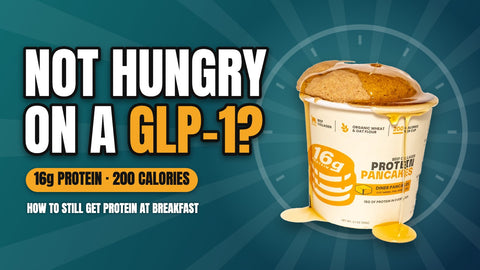
GLP-1 medications like semaglutide (Ozempic, Wegovy) and tirzepatide (Mounjaro, Zepbound) work partly by turning down appetite. That's the point. But it also makes it easy to skip breakfast or eat so little that protein falls through the cracks.
Here's what nutrition experts recommend, and how to get protein in when a full breakfast sounds like too much.*
*This article is general information, not medical advice. If you take a GLP-1 medication, talk to your prescriber or a registered dietitian before changing your diet.
Why protein matters more on a GLP-1
When you lose weight, some of what you lose is lean mass, including muscle, not just fat. That's true on GLP-1 medications too.
In 2025, four groups (the American College of Lifestyle Medicine, the American Society for Nutrition, the Obesity Medicine Association and The Obesity Society) published a joint advisory on nutrition for people on GLP-1 therapy. On protein, it says:*
- The standard recommendation for adults is 0.8 grams per kilogram of body weight per day.
- Higher targets of 1.2 to 1.6 grams per kilogram per day have been proposed during active weight loss.
- A simpler alternative is an absolute target of 80 to 120 grams per day.
- Protein alone probably isn't enough to protect muscle. The advisory pairs it with strength training and regular physical activity.
Your prescriber or a registered dietitian can set the right number for you.
The breakfast problem
If you're aiming for 80 to 120 grams of protein a day and you barely eat breakfast, the rest of the day has a lot of catching up to do, with a smaller appetite. Most grab-and-go breakfasts don't help. They're built on refined carbs, with little protein and a lot of sugar.
To help with side effects, the advisory suggests smaller, more frequent meals: a small breakfast, then small meals every 3 to 4 hours, with plenty of fluids. It also recommends nutrient-dense, minimally processed foods, and limiting refined sugars and ultra-processed sweets.
What to look for in a small breakfast
- Protein per bite. When you can only eat a little, make it count. Protein per 100 calories is a useful way to compare.
- A small, set portion. Single servings make it easier to eat a little without overdoing it.
- Not too heavy. The advisory notes that fatty foods can make side effects worse early on, and that foods high in protein or fat slow digestion. A small portion helps.
- Low added sugar. Keep it to 10 grams or less per meal, per the 2025–2030 Dietary Guidelines.
Small breakfasts, ranked by protein per 100 calories
Typical numbers per serving.* Check the label on the brand you buy.
| Option | Protein | Calories | Protein per 100 cal |
|---|---|---|---|
| Plain nonfat Greek yogurt cup | about 15g | about 90 | about 17g |
| 2 large eggs | about 12g | about 140 | about 9g |
| Beef Cakes Diner Pancakes | 16g | 200 | 8g |
| Beef Cakes Maple Pancakes | 16g | 220 | 7.3g |
| Beef Cakes Maple Oatmeal | 14g | 230 | 6.1g |
| Beef Cakes Chocolate Chip Oats | 14g | 250 | 5.6g |
| Flavored instant oatmeal packet | about 4g | about 160 | about 2.5g |
Plain Greek yogurt and eggs are hard to beat, and we'd tell you to eat them. Beef Cakes is the option for mornings when you want something warm and you're not cooking. Our Diner Pancakes have 16 grams of protein in 200 calories, with just 1.5 grams of fat and 5 grams of added sugar. Compare that to a flavored instant oatmeal packet: about 4 grams of protein in 160 calories.
Tips for mornings you're not hungry
- Eat the protein first. The advisory suggests eating protein-rich foods first in a meal, so if you stop early, you've still gotten it.
- Go small, then snack. A small breakfast now and another small, protein-forward snack mid-morning fits the advisory's pattern better than one big meal.
- Keep it simple. On busy mornings, a breakfast you don't have to cook is the one you'll actually eat. Add 1/4 cup water, stir, microwave 60 seconds.
- Drink water. The advisory stresses staying hydrated on GLP-1 therapy.
See all our protein pancake cups and protein oatmeal cups, or read how much protein to eat at breakfast.
Quick answers
How much protein should I eat on a GLP-1?
A 2025 joint advisory from four obesity and nutrition groups notes that targets of 1.2 to 1.6 grams per kilogram of body weight per day have been proposed during active weight loss, or an absolute target of 80 to 120 grams per day. Your prescriber or dietitian can set the right number for you.
What should I eat for breakfast if I'm not hungry on Ozempic?
Something small and protein-forward. Plain Greek yogurt, eggs or a single-serve protein pancake or oatmeal cup are options. To help with side effects, the advisory suggests a small breakfast followed by small meals every 3 to 4 hours.
Is it okay to skip breakfast on a GLP-1?
Talk with your care team about what works for you. To help with side effects, the 2025 advisory suggests smaller, more frequent meals, such as a small breakfast and then small meals every 3 to 4 hours.
Can I eat Beef Cakes on a GLP-1 medication?
Beef Cakes cups are ordinary food, a single-serve breakfast with 14–16 grams of protein and 200–250 calories. They're not designed for or tested with any medication. If you have questions about your diet on a GLP-1, ask your prescriber or a registered dietitian.
*Comparison figures are typical label values and vary by brand. Protein guidance is summarized from the 2025 joint advisory cited above and the 2025–2030 Dietary Guidelines for Americans; individual needs vary. This article is for general information and isn't medical advice. Talk to your healthcare provider about your diet while taking any medication. Ozempic, Wegovy, Mounjaro and Zepbound are trademarks of their respective owners. Beef Cakes is not affiliated with them.